
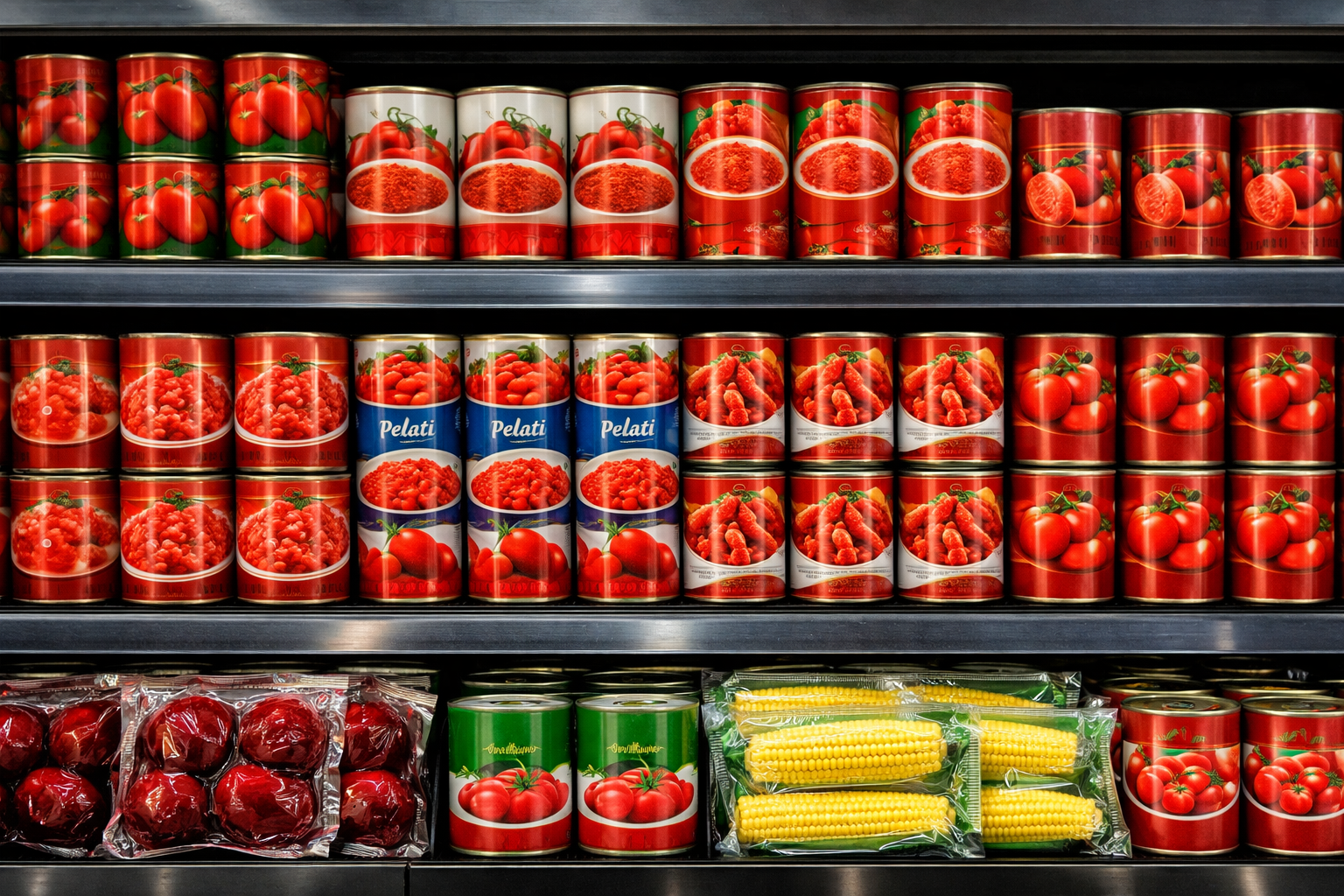
🍅 A Category Defined by Origin, Not Just Product
Tomato products are one of the most stable and high-volume categories in the Israeli food market — spanning retail, HORECA, and industrial use.
But unlike many commodity categories, in Israel, the decision is often not just about price or format.
👉 It’s about the origin
Italian tomatoes, especially in crushed and cut formats, have built a dominant position across all segments, from supermarket shelves to large-scale industrial supply.
🇮🇹 Why Italian Tomatoes Lead in Israel
Israeli buyers — both retail consumers and professionals — associate Italian tomato products with:
- Consistent quality
- Balanced flavor profile
- Trusted raw material sourcing
- Authentic Mediterranean positioning
Over the years, this perception has turned into a default market preference.
➡️ In many cases, “tomato products” in Israel are implicitly expected to be Italian
💡 Key Insight: This Is Not Just a Supply Chain — It’s a Trust Chain
Italian tomato products have built more than distribution — they’ve built credibility across the entire value chain:
- Retail buyers trust shelf performance
- Chefs trust cooking consistency
- Industrial users trust raw material behavior
👉 That level of trust creates entry barriers for alternative origins
📦 Retail Consumption: 3-Pack Formats & Shelf Strategy
In supermarkets, crushed and cut tomatoes are widely sold in:
- 3-pack tin formats (retail-focused)
- Standard single tins (400g / similar sizes)
- Increasing private label options
Key observations:
- Italian origin is often highlighted clearly on packaging
- Even private labels frequently rely on Italian sourcing behind the brand
- Shelf positioning is highly competitive but stable, dominated by known references
Consumers tend to:
- Stock up (multi-pack purchasing behavior)
- Use tomatoes as a pantry staple
- Show loyalty to trusted origins rather than experimenting frequently
✅ Practical implication
Retail success depends less on innovation — and more on credibility and consistency
🏷️ Private Label Dominance (with Italian Backbone)
Large Israeli retail chains are heavily invested in private label development
But in this category: 👉 Many private label tomato products are still sourced from Italy
Why?
- Ensures quality consistency
- Matches consumer expectations
- Reduces perceived risk
➡️ Result:
Italian producers are often behind both:
- Branded products
- Supermarket-owned brands
🍳 HORECA & Catering: 2.5kg and 5kg Formats
In foodservice, crushed and chopped tomatoes are a core ingredient.
Common formats:
- 2.5 kg tins
- 5 kg tins
Used across:
- Restaurants
- Hotels
- Catering kitchens
Why Italian products dominate here:
- Reliable cooking behavior
- Stable acidity and flavor
- Consistency across large batches
💡 Key factor
Chefs prioritize predictability over price fluctuations
🏭 Industrial Use: 200kg+ Drums as Raw Material
Beyond retail and foodservice, tomato products are widely used as industrial inputs.
Typical formats:
- ~210 kg drums
- Bulk aseptic packaging
Used in:
- Sauce production
- Ready meals
- Food manufacturing
Italian suppliers remain strong due to:
- Scale capability
- Established processing standards
- Long-term contracts with importers
➡️ At the industrial level, performance consistency becomes critical and measurable
📈 Market Behavior & Consumption Patterns
Key structural characteristics of the Israeli tomato category:
- High per capita tomato consumption
- Strong use in home cooking and foodservice
- Heavy reliance on processed tomato formats (not only fresh)
- Year-round demand (not seasonal)
Consumer trends supporting growth:
- Preference for cooking at home (especially post-pandemic habits)
- Continued demand for Mediterranean-style meals
- Increasing reliance on convenient base ingredients
⚙️ What Buyers Look for (Across Segments)
Whether retail, HORECA, or industrial, buyers evaluate:
- Brix level consistency
- Texture (not too watery / not too thick)
- Color (deep red, natural appearance)
- Flavor stability
- Packaging reliability
✅ Important
Technical parameters matter — but perception of origin often plays equal role
🚫 Challenges for Non-Italian Suppliers
Despite competitive pricing, alternative origins face clear barriers:
- Lower trust perception
- Need for aggressive pricing to enter
- Difficulty replacing established SKUs
- Reluctance from retailers to change core category products
👉 Many buyers will ask:
“If it works with Italian supply — why change?”
📦 Packaging & Positioning Strategy
Success depends on aligning format with channel:
Retail
- 3-pack tins
- Strong origin messaging
- Clean, familiar design
HORECA
- Large tins (2.5–5 kg)
- Functional and reliable packaging
Industrial
- Bulk aseptic drums
- Focus on specs, not branding
🇮🇱 Israel-Specific Requirements
To operate in this category:
- Hebrew labeling required (retail)
- Importer details mandatory
- Kosher certification is often expected
- Shelf-life clarity critical (especially bulk formats)
➡️ As a mature category, compliance must be flawless, not approximate
🚀 Conclusion: A Mature Category with Locked-In Preferences
Crushed and cut tomatoes in Israel are not just a commodity —
They are a structured, origin-driven category
Italian producers dominate not only because of supply capability, but also because of:
- Long-term trust
- Consistent performance
- Market familiarity
For new entrants, success requires:
- Clear differentiation strategy
- Strong importer partnerships
- Patience and consistency
🎯 Strategic Takeaway
This is a category where:
- The volume is high
- The behavior is stable
- The loyalty is strong
👉 Breaking into it is possible —
but only with precision, not price alone

